
Stingray Marine Solutions
Reducing CO₂ Emissions from Wellboat Sea Lice Delousing in Salmon Farming
CaseStingray Marine Solutions partnered with the Terravera Foundation to assess how continuous laser-based sea lice removal inside salmon pens could reduce dependence on fossil-fuel-intensive wellboat operations in Norwegian aquaculture.
The modelling shows that replacing reactive vessel-based delousing with continuous in-pen optical control could reduce treatment operations by up to 50%, corresponding to approximately 106,000 tonnes of CO₂, while also reducing fish handling, biological stress, and treatment-related mortality.
How Sea Lice Treatment Drives Fuel Consumption and CO₂ Emissions in Salmon Farming
Sea lice remain one of the largest operational challenges in salmon aquaculture. Under Norway’s regulatory “traffic light” system, farms exceeding lice thresholds must carry out immediate delousing to maintain production capacity and regulatory compliance.
In practice, this means transporting large volumes of salmon into specialised wellboats for treatment using thermal bathing, freshwater flushing, brushing, or medicinal methods before returning the fish to the sea pens.
Continuous In-Pen Laser Delousing as an Alternative to Wellboat Treatment
Stingray’s optical delousing system uses underwater cameras, machine learning, and precision lasers to identify and shoot sea lice directly inside salmon pens while the fish continue swimming freely and unharmed.
Unlike conventional delousing, the technology enables continuous lice control throughout the production cycle without bothering the fish. This shifts sea lice management from large-scale reactive interventions toward continuous preventive control directly within the cage environment.
Peer-reviewed research (see end of article) indicates that sites using optical delousing experience up to 50% lower likelihood of requiring weekly mechanical or medicinal delousing treatments compared to conventional operations.
Terravera data modelling
What is being modelled
CO₂ emissions from sea lice treatment operations in salmon farming.
What the model actually does
The model quantifies fuel use and operational activity from wellboat-based delousing, including treatment frequency across farms and associated vessel activity. It also accounts for emissions from deploying optical delousing technology.
Core comparison
Reactive, vessel-based delousing operations versus continuous in-pen optical delousing with reduced treatment frequency.
Output
Net CO₂ emissions difference across production scenarios.
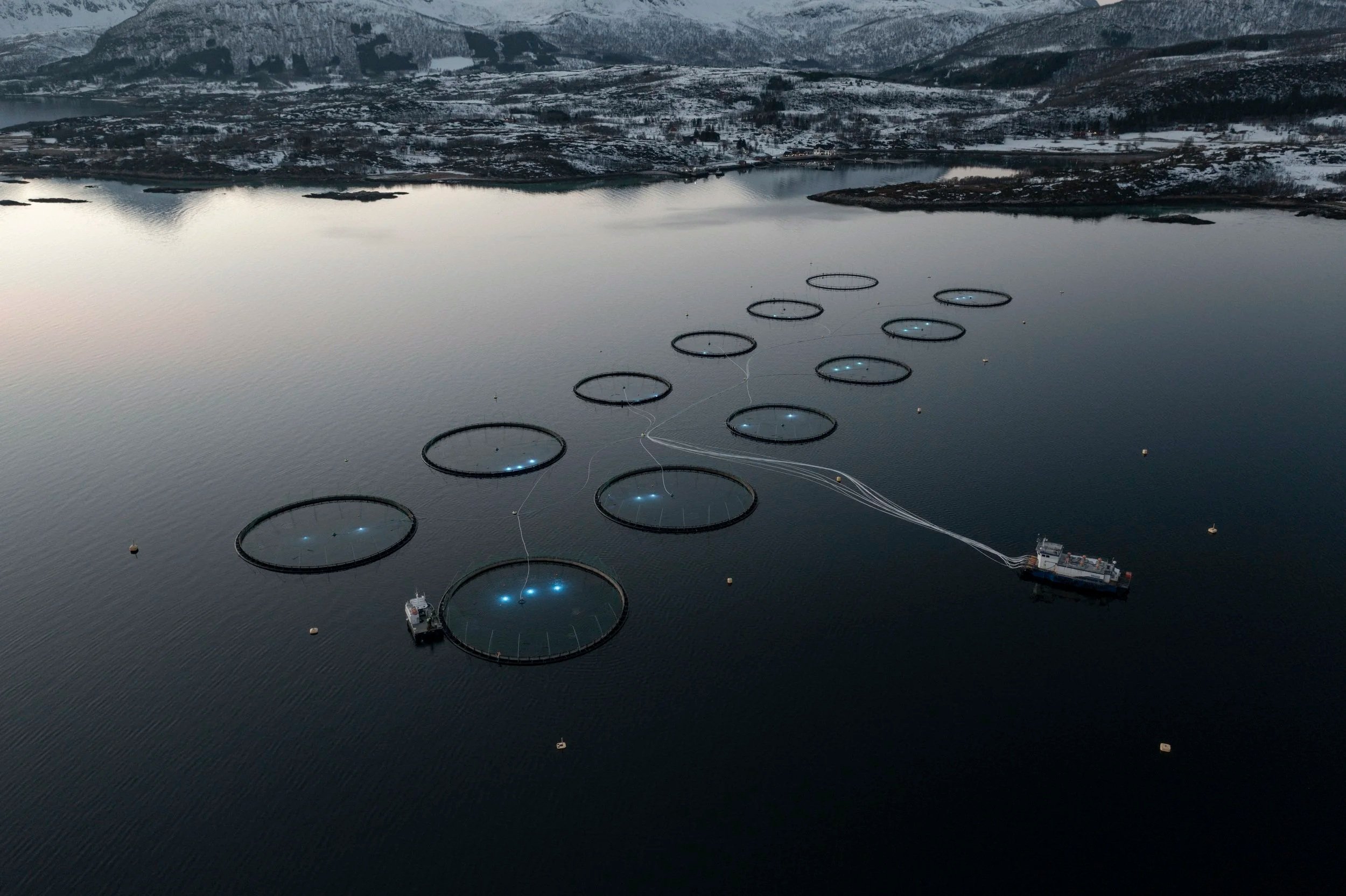
Modelling CO₂ Emissions from Wellboat Delousing Operations
Terravera developed an operational emissions model to quantify greenhouse gas emissions associated with reactive wellboat-based delousing and assessed how reduced treatment frequency could affect emissions intensity across salmon farming systems.
The model simulated a scenario where annual delousing operations were reduced from 2,609 to 1,304 through adoption of continuous optical delousing.
The analysis estimated an emissions reduction of approximately:
106,000 tonnes CO₂ (mid-case)
53,000 tonnes CO₂ (low-case)
158,000 tonnes CO₂ (high-case)
The mid-case estimate corresponds to approximately 14,800 commercial flights between Oslo and Bergen.
The model also incorporated life cycle assessment data for Stingray hardware, showing that emissions associated with manufacturing the optical delousing system are comparatively small relative to avoided operational emissions in high-utilisation farming systems.
The findings are conservative and exclude indirect emissions from support vessels, chemical production, and auxiliary operational systems.
What Reduced Wellboat Dependency Means
for Low-Emission Salmon Farming
The model shows that reducing dependence on wellboat-based delousing can materially lower the operational carbon intensity of sea lice management in salmon farming.
More broadly, the findings point toward a structural shift in how biological challenges are managed in aquaculture: from fuel-intensive treatment campaigns requiring large-scale fish handling toward continuous in-pen control with lower operational energy demand.
Combined with electrification initiatives and emerging low-emission vessel technologies, continuous optical delousing may represent an important pathway for reducing lifecycle emissions associated with salmon production.
Terravera Sustainability Modelling for Aquaculture Operations
Terravera translates operational aquaculture data into quantified environmental and biological impact assessments that support evidence-based decision-making.
For Stingray, this enabled a comparative analysis of how different sea lice management strategies influence operational emissions, treatment dependency, and biological pressure across salmon farming systems.
“For Stingray, Terravera’s modelling provides clear evidence of how operational changes in sea lice management can reduce emissions, treatment frequency, and biological pressure across salmon farming systems.”
— Linn Kathrin Bergset, Head of Sustainability, Stingray Marine Solutions
Methodology and Sources
The assessment combines operational aquaculture data, peer-reviewed research, and public industry reporting related to sea lice treatment, wellboat operations, emissions, and fish welfare.
Selected sources include:
Worm, M. et al. Control of salmon lice through optical delousing in commercial salmonid aquaculture. Aquaculture (2026)
ZeroKyst & Stakeholder AS. Mapping of emissions from fisheries and aquaculture in Norway (2022)
Leine, M.S. et al. What is needed for well boats to reach zero emissions? NTNU (2023)
Nordlaks. Sustainability Report 2022
International Civil Aviation Organization (ICAO). Carbon Emissions Calculator
Detailed modelling quantifications and source methodology available upon request.